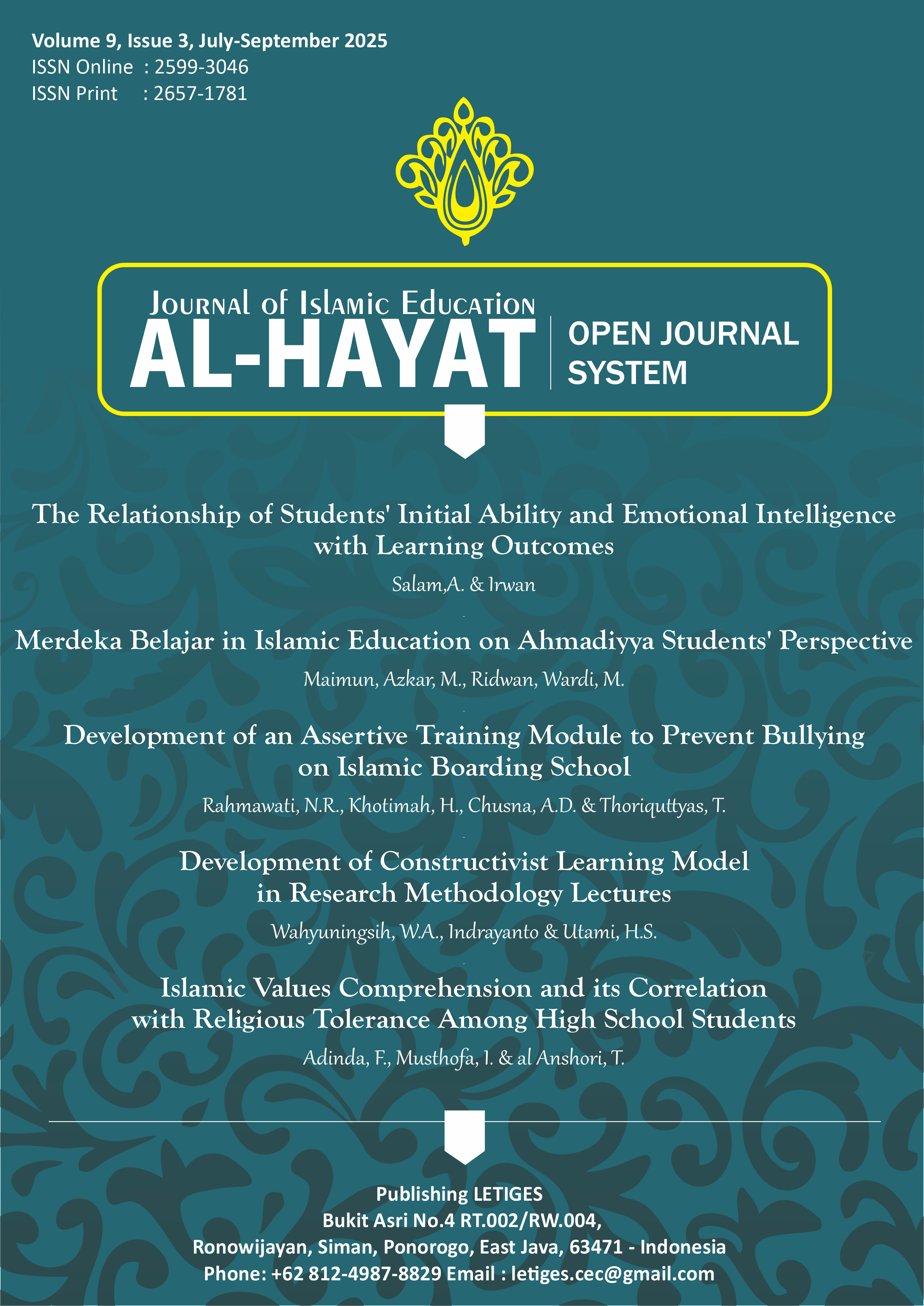
The Relationship of Students' Initial Ability and Emotional Intelligence with Learning Outcomes
DOI:
https://doi.org/10.35723/ajie.v9i3.63Keywords:
Initial Abilities, Emotional Intelligence, Learning Outcomes, Regression AnalysisAbstract
This study aims to determine the relationship between initial abilities and emotional intelligence with student learning outcomes. This study uses a quantitative approach with a survey method and correlational analysis techniques. The study population consisted of 120 PGMI students of the 2022/2023 intake. The study population of students of the 2022/2023 intake was 120 students. The results of this study were processed using regression analysis techniques of simple correlation, partial correlation, regression, and multiple correlation. The study found that there was a positive and significant correlation between (a) Initial abilities (X1) and learning outcomes (Y) with Ŷ = 7.93 + 1.938 X1 and ry1 = 0.798; (b) emotional intelligence (X2) and learning outcomes (Y) with Ŷ = 18.94 + 0.186X2 and ry2 = 0.90. So it is known that there is a positive relationship between initial ability (X1) and emotional intelligence (X2) with student learning outcomes (Y) with Ŷ = 21.1 + 0.103 X1, +0.33X2 and a correlation coefficient of ry12 = 0.87. This study is limited to PGMI students of the 2022/2023 intake at one institution with a correlational design, so it cannot be generalized and does not show a causal relationship. In addition, other factors such as learning motivation and environment were not analyzed. This study combines initial ability and emotional intelligence as predictors of learning outcomes in the PGMI context, resulting in a multiple regression model with a strong correlation that can be used as a basis for developing educational strategies.
References
Using Kolmogorov-Smirnov, Anderson-Darling, and Shapiro-Wilk. Eigen Mathematics Journal, 6(1), 11–19. https://doi.org/10.29303/emj.v6i1.131
[2] Akyıldız, S. T., & Ahmed, K. H. (2021). An Overview of Qualitative Research and Focus Group Discussion. International Journal of Academic Research in Education, 7(1), 1–15. https://doi.org/10.17985/ijare.866762
[3] Amanda, D. D. … Ratnasari, D. (2025). Pengaruh Regulasi Emosi Siswa terhadap Proses Pembelajaran di Kelas. Jurnal Pendidikan Tambusai, 9(1), 1443–1448. https://jptam.org/index.php/jptam/article/view/24401
[4] Amelia, R. E. … Fitrianingtyas, A. (2021). Pengaruh Regulasi Emosi terhadap Interaksi Sosial Selama Pembelajaran Home Visit Akibat Pandemi Covid-19 di TK B. Jurnal PG-PAUD Trunojoyo : Jurnal Pendidikan Dan Pembelajaran Anak Usia Dini, 8(2), 10–20. https://doi.org/10.21107/pgpaudtrunojoyo.v8i2.11350
[5] Anandita, A. … Baihaqi, H. (2025). Enhancing Physics Learning with Advance Organizer: A Meta-Cognitive Approach. Konstan - Jurnal Fisika Dan Pendidikan Fisika, 10(1). https://doi.org/10.20414/konstan.v10i01.641
[6] Anjarwati, L., & Juliprijanto, W. (2021). Determinan Pengangguran Terdidik Lulusan Universitas di Pulau Jawa. Jurnal Ekonomi Pembangunan, 10(3), 178–187. https://doi.org/10.23960/jep.v10i3.280
[7] Cristina, G. (2024). Acehnese Folklore and Social Behavior. Journal of Aceh Studies, 1(1), 51–60. https://doi.org/10.63924/joas.v1i1.47
[8] Dawadi, S. … Giri, R. A. (2021). Mixed-Methods Research: A Discussion on its Types, Challenges, and Criticisms. Journal of Practical Studies in Education, 2(2), 25–36. https://doi.org/10.46809/jpse.v2i2.20
[9] Dharmawati, A. … Wardiyah, M. L. (2025). Analisis Hubungan Preferensi Mata Kuliah dengan Motivasi Belajar Mahasiswa Akuntansi Syariah UIN Bandung Tahun 2023. Jurnal Kendali Akuntansi, 3(3), 26–40. https://doi.org/10.59581/jka-widyakarya.v3i3.5173
[10] Dhewy, R. C. (2022). Pelatihan Analisis Data Kuantitatif Untuk Penulisan Karya Ilmiah Mahasiswa. J-ABDI: Jurnal Pengabdian Kepada Masyarakat, 2(3), 4575–4578. https://doi.org/10.53625/jabdi.v2i3.3224
[11] Fajartriani, T. … Karsiwan, W. (2024). Peran Pendidikan Dalam Meningkatkan Kualitas Sumber Daya Manusia. Jealo, 6(1), 9–17. https://journal.umbogorraya.ac.id/index.php/jealo/article/view/318
[12] Huseng, A. M. … N, N. (2025). Taxonomi Pendidikan Dimensi Pengetahuan, Sikap, dan Keterampilan. Socius: Jurnal Penelitian Ilmu-Ilmu Sosial, 2(9), 107–116. https://doi.org/10.5281/zenodo.15301124
[13] Justan, R. … Sumiati, S. (2024). Penelitian Kombinasi (Mixed Methods). Ulil Albab : Jurnal Ilmiah Multidisiplin, 3(2), 253–263. https://doi.org/10.56799/jim.v3i2.2772
[14] Kumar, M., & Mishra, R. (2016). Emotional Maturity and Academic Achievement among Adolescent Students: A Review of Studies. International Journal of Indian Psychology, 3. https://doi.org/10.25215/0304.035
[15] Mardiyanti, S. (2023). Pengaruh Kematangan Emosional Terhadap Motivasi Belajar Siswa. Malih Peddas (Majalah Ilmiah Pendidikan Dasar), 13(1). https://doi.org/10.26877/malihpeddas.v13i1.15919
[16] Muntasir, M., & Akbar, I. (2023). Revisiting the Significance of ZDP and Scaffolding in English Language Teaching. JETLEE : Journal of English Language Teaching, Linguistics, and Literature, 3(1), 40–45. https://doi.org/10.47766/jetlee.v3i1.1276
[17] Mwita, K. (2022). Factors influencing data saturation in qualitative studies. International Journal of Research in Business and Social Science (2147- 4478), 11(4), 414–420. https://doi.org/10.20525/ijrbs.v11i4.1776
[18] Nurhayati … Ahsan, N. H. J. (2024). Metodologi Penelitian Kualitatif (Teori dan Praktik). PT. Sonpedia Publishing Indonesia.
[19] Oktaviani, U. … Susanti, E. (2020). Identifikasi Faktor Penyebab Rendahnya Hasil Belajar Matematika Peserta Didik di SMK Negeri 1 Tonjong. Math Locus: Jurnal Riset Dan Inovasi Pendidikan Matematika, 1(1), 1–6. https://doi.org/10.31002/mathlocus.v1i1.892
[20] Purwanza, S. W. (2022). Metodologi Penelitian Kuantitatif, Kualitatif Dan Kombinasi. CV. Media Sains Indonesia.
[21] Rabindran, R., & Madanagopal, D. (2020). Piaget’s Theory and Stages of Cognitive Development- An Overview. Scholars Journal of Applied Medical Sciences, 8(9), 2152–2157. https://doi.org/10.36347/sjams.2020.v08i09.034
[22] Rudiyanti, N. … Purnamasari, P. (2025). Pengaruh Strategi Pemasaran Terhadap Penambahan Segmen Pasar Baru Di Restoran Kopi Express. Jisosepol: Jurnal Ilmu Sosial Ekonomi Dan Politik, 3(1), 132–138. https://doi.org/10.61787/zk322946
[23] Safitri, A. … Prihantini, P. (2022). Pentingnya Memahami Karakteristik Peserta Didik Sekolah Dasar untuk Meningkatkan Efektivitas Belajar dalam Mata Pelajaran Bahasa Indonesia. Jurnal Pendidikan Tambusai, 6(2), 9333–9339. https://doi.org/10.31004/jptam.v6i2.3886
[24] Salam, A. (2022). Metode Penelitian Kualitatif. CV. Azka Pustaka.
[25] Samsudin, M. (2020). Faktor-Faktor yang Memengaruhi Belajar. Eduprof : Islamic Education Journal, 2(2), 162–186. https://doi.org/10.47453/eduprof.v2i2.38
[26] Sari, E. R. … Purnama, M. (2023). Kreativitas Guru Melibatkan Ragam Model Pembelajaran dalam Kegiatan Pembelajaran Matematika terhadap Keberhasilan Belajar Siswa di Sekolah Dasar. Journal on Education, 5(3), 8947–8959. https://jonedu.org/index.php/joe/article/view/1691
[27] Siregar, I. A. (2021). Analisis Dan Interpretasi Data Kuantitatif. Alacrity : Journal of Education, 1(2), 39–48. https://doi.org/10.52121/alacrity.v1i2.25
[28] Sofwatillah … Saksitha, D. A. (2024). Teknik Analisis Data Kuantitatif dan Kualitatif dalam Penelitian Ilmiah. Jurnal Genta Mulia, 15(2). https://ejournal.uncm.ac.id/index.php/gm/article/view/1147
[29] Srivastava, M., & Jaiswal, S. (2022). Emotional quotient vs. intelligence quotient to achieve professional excellence in life: a systematic literature review. International Journal Of Community Medicine And Public Health, 9(12), 4662–4665. https://doi.org/10.18203/2394-6040.ijcmph20223229
[30] Taherdoost, H. (2022). What are Different Research Approaches? Comprehensive Review of Qualitative, Quantitative, and Mixed Method Research, Their Applications, Types, and Limitations. Journal of Management Science & Engineering Research, 5(1), 53–63. https://doi.org/10.30564/jmser.v5i1.4538
[31] Thalib, M. A. (2022). Pelatihan Teknik Pengumpulan Data dalam Metode Kualitatif untuk Riset Akuntansi Budaya. Seandanan: Jurnal Pengabdian Pada Masyarakat, 2(1), 44–50. https://doi.org/10.23960/seandanan.v2i1.29
[32] Wardah, A. … Bakar, M. Y. A. (2025). Mengidentifikasi Pembelajaran Berbasis Kemampuan Awal: Menyesuaikan Pengajaran Dengan Potensi Siswa. Jurnal Ilmiah Nusantara, 2(3). https://doi.org/10.61722/jinu.v2i3.4642
[33] Wulandari, H., & Nurhaliza, I. (2023). Mengembangkan Potensi Guru Yang Profesional Dalam Proses Belajar Mengajar. Didaktik : Jurnal Ilmiah PGSD STKIP Subang, 9(2), 2487–2509. https://doi.org/10.36989/didaktik.v9i2.990
[34] Wulandari, K. D. … Bakar, M. Y. A. (2024). Optimalisasi Pembelajaran Melalui Pemahaman Kemampuan Awal Peserta Didik. Jurnal Sains Student Research, 2(6). https://doi.org/10.61722/jssr.v2i6.2902
Downloads
Published
Issue
Section
License
Copyright (c) 2025 Agus Salam, Irwan (Author)

This work is licensed under a Creative Commons Attribution 4.0 International License.
The AJIE content is licensed under a Creative Commons Attribution 4.0 International license (CC BY 4.0). Authors retain unrestricted copyright and publishing rights of their articles. Authors grant the Publisher the Affairs Al-Hayat Al-Istiqomah Foundation a license to publish the article and identify itself as the original publisher. Authors also grant any third party the right to use or reuse the article freely as long as its original authors and citation details are identified.